Thankfully, just in time for my animation to be due, Chris delivered the final music piece to me. This one was my favourite of all of them by far, and I was very pleased to be able to use it with my animation. I think it captures the mood of the poem and the emotions I am trying to convey very well. It is especially tailored to the visuals, so the highs and lows, changes in tempo and pauses mimic the action on screen.
As well as this recorded music track, I wanted to include some sampled sound effects to the piece. My idea was to keep them very sparse, so only use about 5 or 6 in the entire compositions: just enough to enhance the narrative and visuals but without being any kind of a focal point. The sound clips I downloaded from freesfx.co.uk, which is all completely free and royalty free, which was great to find. On the website I discovered an entire bank of sound clips to choose from, and each one met my specific needs very well.
In order to add the sound files onto the visuals, I had to learn methods of combining the two with software. As I have never really worked with sound before, I thought this would be a challenge for me. As I was using Adobe Premiere Pro to edit the entire short's final output, I watched some videos online about using Premiere Pro for sound editing. I found the process relatively simple, and I picked up the technical knowledge quickly.
Showing posts with label website. Show all posts
Showing posts with label website. Show all posts
Sunday, 15 December 2013

Tuesday, 3 December 2013
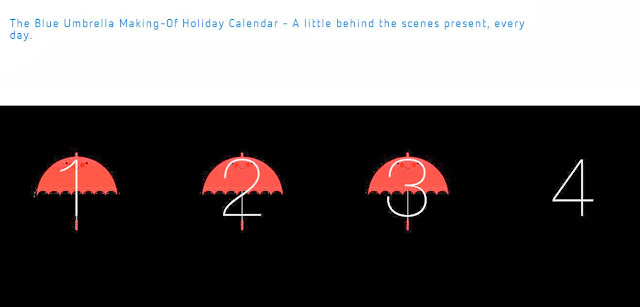
The Blue Umbrella Making-Of Holiday Calendar
The Pixar creators of the short film 'The Blue Umbrella' are releasing a day-by-day behind the scenes look at the making of their film for the entire advent period. On the website http://www.theblueumbrellamakingofholidaycalendar.com/ an advent calendar of little umbrella animations is displayed. With every passing day, a new one becomes clickable to reveal a snippet of behind the scenes action. Themes for pieces include inspiration behind the film, script writing process and the animatics behind the finished animation. I think this will come in particularly useful to me over the course of the next month in my animation studies.

Monday, 21 October 2013
Complaints in 'The Simpsons'
I read an interesting article on The Telegraph website (by Charlotte Runcie) regarding 'The Simpsons,' censorship and public reception. It detailed all the complaints that had been made in the USA in the past 3 years by the public to the Federal Communications Commission (FCC). This reminded me of the reading a few weeks previous from Forbidden Animation by Cohen. It brings in to question the notion of decency in cartoons. The complains listed show that even now, years after the harsh standards of cartoon decency in the early 20th century, many viewers still take a hard line on what they consider appropriate to be shown in cartoon form.
Some of the complains were made to address the show's apparent use of 'bad language,' such as poop, pee and toosh. Others called in to question some of the show's scenes of partial nudity, while more complaints still made accusations of blastphemy in episodes such as the Tree-house of Horror specials.
The prudish nature of these complains makes one question whether some viewers are easily offended and very particular, or whether the public takes a harder line on scenes of a mildly graphic nature and minimal swearing because they are being depicted in cartoon form, and as such they expect it to be more childishly innocent and produced with a young and impressionable audience in mind.

DreamWorks Animation Production Process
Dreamworks Animation, which is based in Glendale, California, is an American animation studio that creates animated feature films, television programs, and online virtual worlds. On their website they have a 'Behind The Scenes' section, which gives information about their productions, their employees, their company culture, and the technology they work with.
I found the section about the production process to be very informative and useful. The website allows you to browse through a slideshow which details each stage of the production of a film, from script writing through to release. It also gives the time frames for each of the stages. I found out, much to my surprise, that up to 18 months can be spend on the storyboarding process to get it just right! This really made me rethink my view on the importance of storyboarding in the development of animation.
By learning about each of the departments and the stages that they are responsible for, I got a better idea of what I would personally like to work in, if I ever was employed in a large studio. The visual development department looks very interesting, and a way to work specifically with creating artwork. Each feature film they create averages 5 years in production length before release.
I learned a lot of terminology through the slides such as 'armature,' 'rigging,' 'surfacing' and 'assets.'

A second section detailing the technical specifications of their films and the equipment they use at DreamWorks' studios was mind-blowing. In a single 90 minute feature, up to 120,000 frames need to be created and stored. The technology that's required for one film includes 300+ graphics workstations, 60+ million render hours, 17,000 cores used simultaneously, and upwards of 200+TB of disk space. That is a millions times more than anything I could ever aspire to achieve technically, let alone while still in university. I know that some smaller animation companies send their work for rendering to 'render farms' so that they don't have to spend a large budget or time on this labour-intensive process. DreamWorks artists use tablets like Cintiq, as well as scanning in hand-drawn images, which gives me more purpose in doing this myself for my own pre-production process.

Friday, 18 October 2013
Toon Boom Animate Pro II

On the Toon Boom website https://www.toonboom.com/ there are a myriad of resources for beginners to learn to use the software. I was able to access video tutorials, walkthroughs, FAQs, guides and forums to help me ease into familiarity with the software. They also have a section of tips and tricks for animators. My tutor recommended Toon Boom to study personally as an advanced version of Adobe Flash. So far I have been following the tutorials regularly to try to become familiar with the Animate Pro II interface.
Sunday, 29 September 2013
Information Is Beautiful
Information Is Beautiful is a website created by David McCandless, a London-based author, writer and designer turned data journalist. He says that a passion of his is visualizing information – facts, data, ideas, subjects, issues, statistics, questions – all with the minimum of words. With his team on his website, he creates visualisations, diagrams and infographics to distill the worlds data into beautiful designs that are visually pleasing. He avoids using pie-charts in any form.
The website is a great source of information for anyone interested in creating infographics.

Subscribe to:
Posts (Atom)